Wednesday, 11 February 2015

1st generation of Computer:


 From 1940-1956

 Basic technology used was Vacuum tube.

 Famous names of the computers of first generation  computers are MARK-1, UNIVAC, ENIAC.

                                      Images of ENIAC
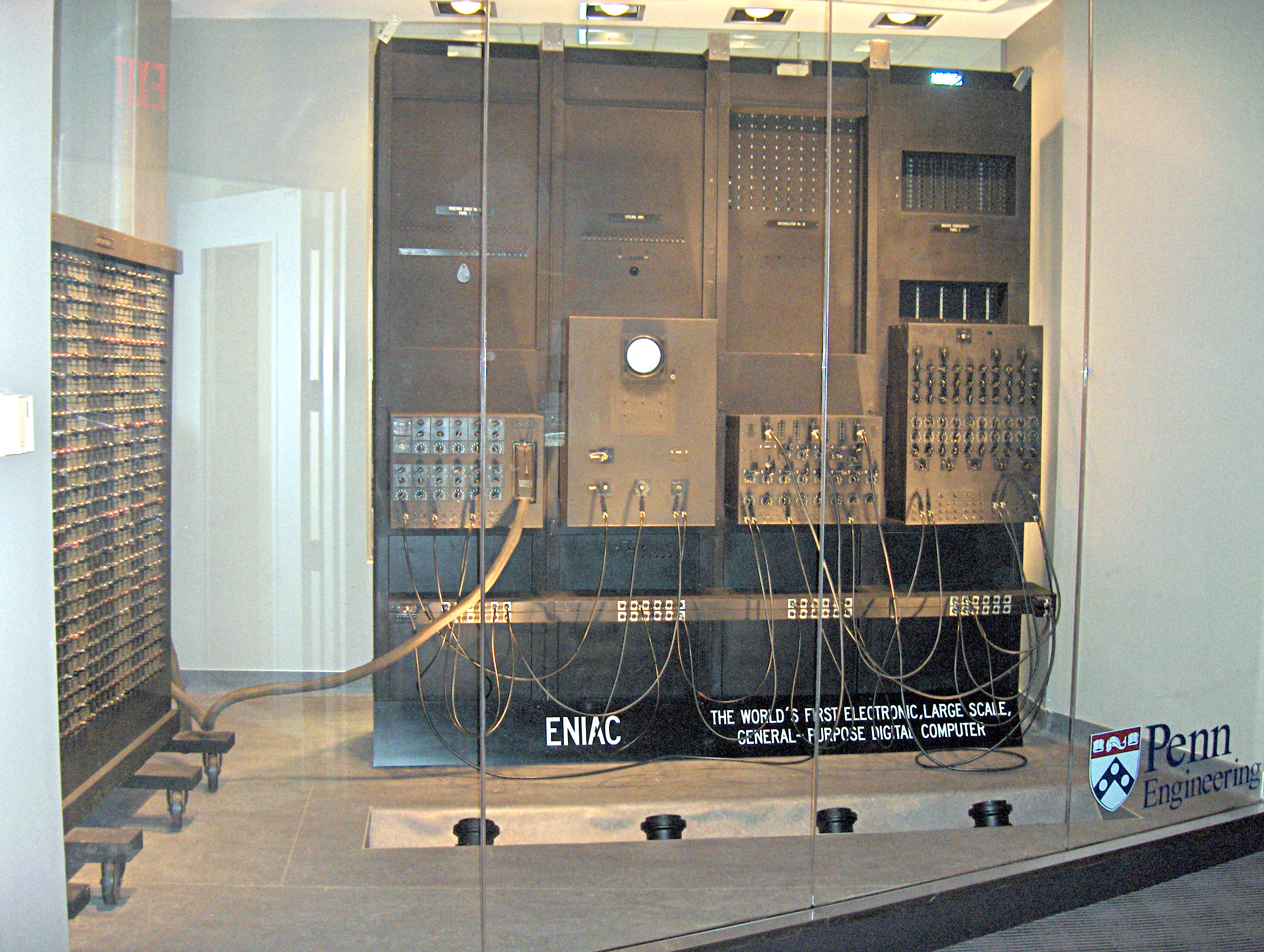


                                     First Generation computers are characterised by the use of vacuum tubes. These vacuum tubes were used for calculation as well as storage and control. Later, magnetic tapes and magnetic drums were implemented as storage media. The first vacuum tube computer, ENIAC, was developed by US army ordinance to calculate ballistic firing tables in WWII. It had about 17 000 vacuum tubes. The machine weighed 30 tons, covered about 1000 square feet of floor, and consumed 130 or 140 kilowatts of electricity. The ENIAC's clock speed was about 100 kHz. In addition to ballistics, the ENIAC's field of application included weather prediction, atomic-energy calculations, cosmic-ray studies, thermal ignition, random-number studies, wind-tunnel design, and other scientific uses. No electronic computers were being applied to commercial problems until about 1951.

Vacuum tube circuit

picture of vacuum tube circuitThis is an example of a vacuum tube based circuit used in a first generation computer (a Burroughs), pictured here next to a transistor based circuit, with similar functionality, from a second generation computer (the IBM 1620). The vacuum tubes (at the top of the circuit) have been damaged because of overheating. We suspect that this particular circuit is a 4-bit register. Circuits created i this way were extremely bulky. To create a 32-bit ADD circuit would require 800 logic gates using a total of 1,504 transistors. In vacuum tube based computers, this many vacuum tubes would take up a space about the size of a refrigerator.


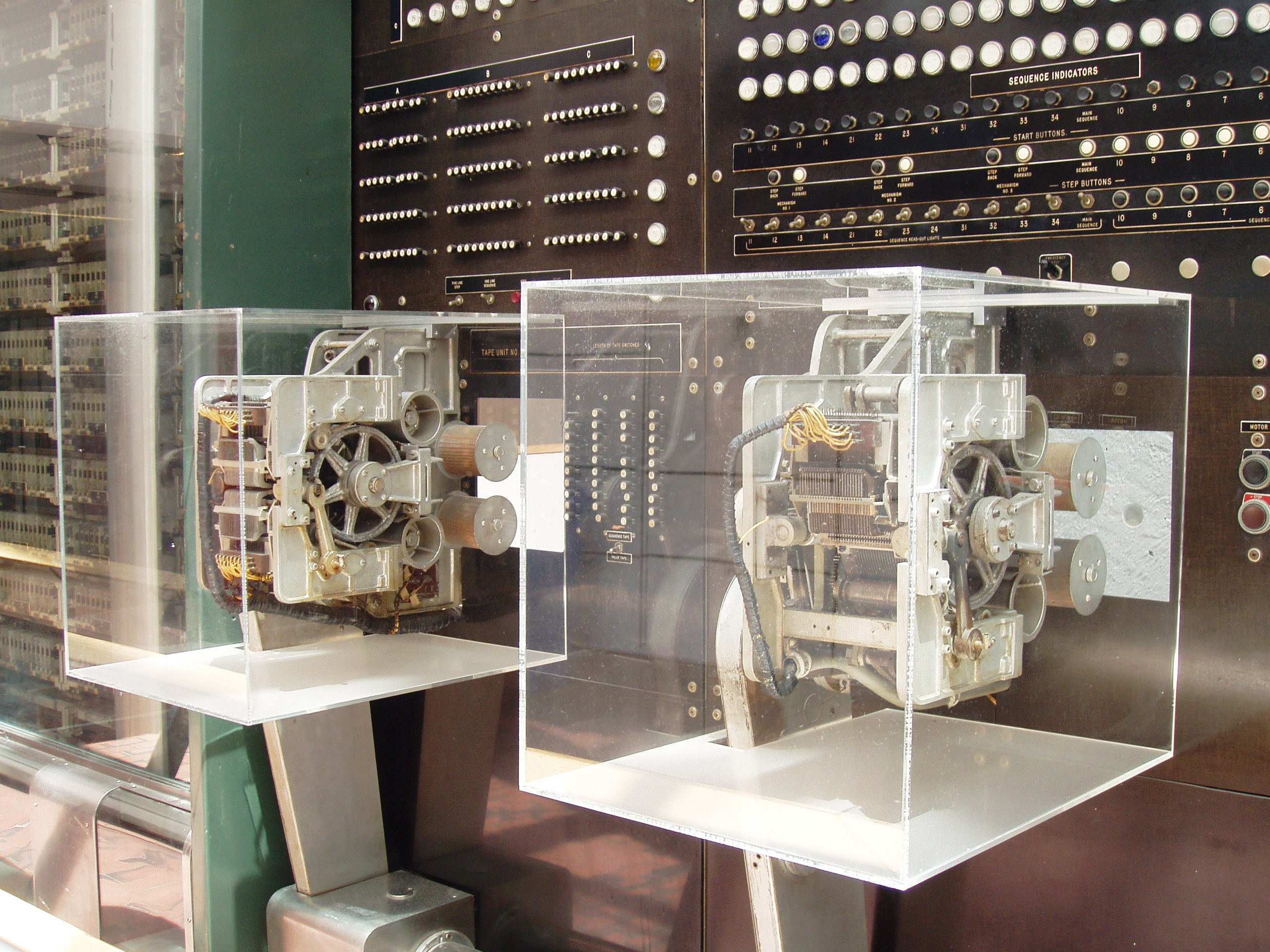
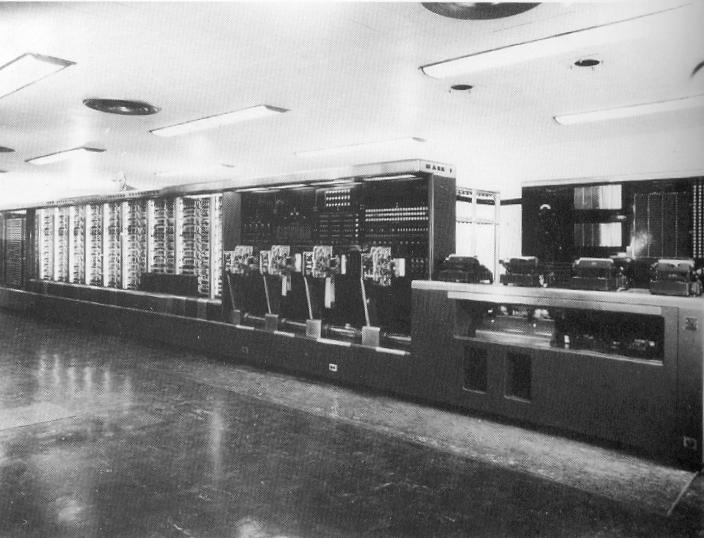
                                                            Images of MARK 1


About MARK-1         

The IBM Automatic Sequence Controlled Calculator (ASCC), called Mark I by Harvard University’s staff,[1] was a general purpose electro-mechanical computer that was used in the war effort during the last part of World War II.
The original concept was presented to IBM by Howard Aiken in November 1937.[2] After a feasibility study by IBM’s engineers,Thomas Watson Sr. personally approved the project and its funding in February 1939.
Howard Aiken had started to look for a company to design and build his calculator in early 1937. After two rejections,[3] he was shown a demonstration set that Charles Babbage’s son had given to Harvard university 50 years earlier. This led him to study Babbage and to add references of the analytical engine to his proposal ; the resulting machine “brought Babbage’s principles of the analytical engine almost to full realization, while adding important new features.”[4]
The ASCC was developed and built by IBM at their Endicott plant and shipped to Harvard in February 1944. It began computations for the U.S. Navy Bureau of Ships in May and was officially presented to the university on August 7, 1944.
One of the first programs to run on the Mark I was initiated on 29 March 1944[5] by John von Neumann, who worked on the Manhattan project at the time, and needed to determine whether implosion was a viable choice to detonate the atomic bomb that would be used a year later. The Mark I also computed and printed mathematical tables, which was Charles Babbage’s initial goal for his analytical engine.
The Mark I was officially retired, after 15 years of service, in 1959.


Friday, 6 February 2015


POLARIZED ZIP PRINTERS:


With the technological advances, we have all gone digital and old classic stuff seems to be a thing of past. Well, not anymore. Polaroid has introduced yet another mobile photo printer by the name of Polaroid Zip that allows users to print pictures taken from their smartphones. It prints a small color print out in about a minute. The printer can print 5x8cm pictures by using Zero Ink Paper that comes from Zink Imaging.


Importance of BLOG :


Blog is used for many purposes and many people are earning millions of dollar per month. Blog writing is very useful for computer users.

If you run a small business, chances are you are wondering if blogging is worth the time and effort. The short answer is a resounding YES! Blogging on a frequent basis is a relatively easy, inexpensive way to enhance your inbound marketing efforts, drive traffic to your site, and attract more perspective customers.
Statistics from Hubspot's 2012 Inbound Marketing Report highlight the importance of blogging. According to the study, 57% of companies who have a blog reported acquiring a customer from their blog. In that same study, a survey of marketers revealed that 81% of businesses say that their business blog is useful to critical for their business.
THE CASE FOR SMALL BUSINESS BLOGS
Here are some of the most important benefits of having a blog for your business:
Boost Search Engine Optimization-Search engines love fresh content. What better way to provide frequent content than with blog posts. By blogging consistently, you give Google and other search engines new content to index and you create opportunities to plug in those all-important keywords to increase your visibility on search engine results pages (SERPS).

Develop Relationships with Potential and Existing Customers-Blogging allows you to connect with your site visitors. This can be accomplished by asking your readers questions at the end of your posts to get the conversation going or by simply allowing comments and feedback. By reviewing and responding to readers’ comments, you can create a rapport with your audience, build trust, and gain valuable insight into what your customers are looking for.

Establish Your Business as an Industry Leader-No matter how small your business is, you can build trust and clout within your industry by providing valuable, expert information in your blog posts. Over time, you become a “go to” resource for helpful, informative content, which can ultimately lead to higher customer conversion rates. This is especially important for small businesses looking to gain credibility to compete with larger companies.

Connect People to Your Brand-Blog posting allows you to show a personal side of your business that perspective and current customers won’t see through outbound marketing techniques. Blogging gives others a sense of the corporate standards, vision, and personality of your company.

Create Opportunities for Sharing-Every time you blog, you create an opportunity for your audience to share your blog with others. Whether they link to your blog post, tweet it, or email it to others, it’s free marketing and it further validates you as a credible business.

From a practical standpoint, blogging just makes sense. With minimal effort and expense, you can build credibility, boost search engine rankings, increase website traffic, and foster relationships with potential and current customers. This is an opportunity no small business should pass up.
Are you interested in creating a blog for your organization? We can help. OpenVine offers a variety of web design solutions to meet your needs. No time to blog? No problem. Our copywriting and content creation team can work with you to create thoughtful, informative posts for your business blog.

Monday, 26 January 2015

Ergonomics


ERGONOMICS:


Since human being feel tired after very short interval so it was necessary to make computer reliable to use for long time and this field helps a lot to solve that problem.


Ergonomics (or human factors) is the scientific discipline concerned with the understanding of interactions among humans and other elements of a system, and the profession that applies theory, principles, data and methods to design in order to optimize human well-being and overall system performance.


    Ergonomics is the field which makes various machines and devices easy to use and this field is very useful in the designing of computer because now a days computer is most useful device. The ergonomists makes the use of computer easier and reliable and convenient.

Thursday, 15 January 2015

E-commerce


Importance and History of E-Commerce


By definition, e-commerce means the buying or selling of goods and services over the Internet. According to the Pew Internet & American Life Project, 66 percent of the adults online have purchased something over the Internet, whether it's books, shoes or a Caribbean cruise.

But if you extend e-commerce's definition to include researching products and services online without buying anything, or bidding on an online auction but not winning, then the number of adults who participate in e-commerce jumps to 93 percent. That's just about all of us.

Even with a slumping global economy, online retail sales continue to rise. According to recent forecasts by Forrester Research, online retail sales will increase 17 percent in 2008 to reach an annual total of $204 billion, with the biggest sellers being clothing, computers and cars.


E-commerce's history is short but fascinating. Over the course of a few decades, networking and computing technology have improved at exponential rates. Powerful personal computers linked to global information networks have powered a whole new world of intellectual, social and financial interactions. And this is only the beginning.

How E-commerce Started

As far back as the 1960s, businesses were using primitive computer networks to conduct electronic transactions . Using something called Electronic Data Interchange (EDI), a company's computer system could share business documents -- invoices, order forms, shipping confirmation -- with another company's computer. In the beginning, each company had its own standards for formatting these documents. But in 1979, the American National Standards Institute (ANSI) came up with something called ASC X12, a universal standard for sharing business documents over electronic networks.
Prior to that, in the late 1960s, the military developed ARPAnet to ensure that crucial communications were circulated in the event of a nuclear attack. The original ARPAnet connected four large U.S. research universities and relied on huge, unwieldy computers. In 1971, researchers developed the Terminal Interface Processor (TIP) for dialing into the ARPAnet from an individual computer terminal . But the greatest networking evolution came in 1982, when ARPAnet switched over to Transmission Control Protocol and Internet Protocol (TCP/IP), the same packet-switched technology that powers the modern Internet.
By the early 1980s, individual computer users -- still mostly at major research universities -- were sending e-mails, participating in listservs and newsgroups, and sharing documents over networks like BITNET and USENET.
CompuServe was one of the first popular networking services for home PC users, providing tools like e-mail, message boards and chat rooms. In the mid-1980s, Compuserve added a service called the Electronic Mall, where users could purchase items directly from 110 online merchants . While the Electronic Mall wasn't a huge success, it was one of the first examples of e-commerce as we know it today.
In 1990, a researcher named Tim Berners-Lee at the European Organization for Nuclear Research (CERN, from its French name) proposed a hypertext-based web of information that a user could navigate using a simple interface called a browser. He called it the "WorldWideWeb". And in 1991, the National Science Foundation lifted a ban on commercial businesses operating over the Internet, paving the way for Web-based e-commerce.
In 1993, Marc Andreesen at the National Center for Supercomputing Applications (NCSA) introduced the first widely distributed Web browser called Mosaic. Netscape 1.0's release in 1994 included an important security protocol called Secure Socket Layer (SSL) that encrypted messages on both the sending and receiving side of an online transaction. SSL ensured that personal information like names, addresses and credit card numbers could be encrypted as they passed over the Internet.
In 1994 and 1995, the first third-party services for processing online credit card sales began to appear. First Virtual and CyberCash were two of the most popular. Also in 1995, a company called Verisign began developing digital IDs, or certificates, that verified the identity of online businesses. Soon, Verisign switched its focus to certifying that a Web site's e-commerce servers were properly encrypted and secure.
Now let's take a closer look at the two companies that transformed e-commerce in the mid-1990s: Amazon and eBay.


Most power ful Supercomputers.

Most powerful Supercomputer:

Tianhe-2:


For the third consecutive time, Tianhe-2, a supercomputer developed by China’s National University of Defense Technology, has retained its position as the world’s No. 1 system with a performance of 33.86 Pflop/s (quadrillions of calculations per second) on the Linpack benchmark.

  It was developed by a team of 1,300 scientists and engineers.
 The development of Tianhe-2 was sponsored by the 863 High Technology Program, initiated by the Chinese government, the government of Guangdong province, and the government of Guangzhou city. It was built by China's National University of Defense Technology (NUDT) in collaboration with the Chinese IT firm InspurInspur manufactured the printed circuit boardsand helped with the installation and testing of the system software.
 FLOPS (for FLoating-point Operations Per Second)
According to NUDT, Tianhe-2 will be used for simulation, analysis, and government security applications.

With 16,000 computer nodes, each comprising two Intel Ivy Bridge Xeon processors and three Xeon Phi coprocessor chips, it represents the world's largest installation of Ivy Bridge and Xeon Phi chips, counting a total of 3,120,000 cores.Each of the 16,000 nodes possess 88 gigabytes of memory (64 used by the Ivy Bridge processors, and 8 gigabytes for each of the Xeon Phi processors). The total CPU plus coprocessor memory is 1,375 TiB (approximately 1.34 PiB).

During the testing phase, Tianhe-2 was laid out in a non-optimal confined space. When assembled at its final location, the system will have a theoretical peak performance of 54.9 petaflops. At peak power consumption, the system itself would draw 17.6 megawatts of power. Including external cooling, the system would draw an aggregate of 24 megawatts. The computer complex would occupy 720 square meters of space.

The front-end system consists of 4096 Galaxy FT-1500 CPUs, a SPARC derivative designed and built by NUDT. Each FT-1500 has 16 cores and a 1.8 GHz clock frequency. The chip has a performance of 144 gigaflops and runs on 65 watts. The interconnect, called the TH Express-2, designed by NUDT, utilizes a fat tree topology with 13 switches each of 576 ports.

Tianhe-2 runs on Kylin Linux, a version of the operating system developed by NUDT. Resource management is based on Simple Linux Utility for Resource Management (SLURM).

Fiber optics

Fiber Optics:


Fiber-optic communication is a method of transmitting information from one place to another by sending pulses of light through an optical fiber. The light forms an electromagnetic carrier wave that is modulated to carry information. First developed in the 1970s, fiber-optic communication systems have revolutionized the telecommunications industry and have played a major role in the advent of theInformation age. Because of its advantages over electrical transmission, optical fibers have largely replaced copper wire communications in core networks in the develope world. Optical fiber is used by many telecommunications companies to transmit telephone signals, Internet communication, and cable television signals. Researchers at Bell Labs have reached internet speeds of over 100 petabits per second using fiber-optic communication.
The process of communicating using fiber-optics involves the following basic steps: Creating the optical signal involving the use of a transmitter, relaying the signal along the fiber, ensuring that the signal does not become too distorted or weak, receiving the optical signal, and converting it into an electrical signal.